Countertop Care and Maintenance: The Complete Guide
September 29, 2026
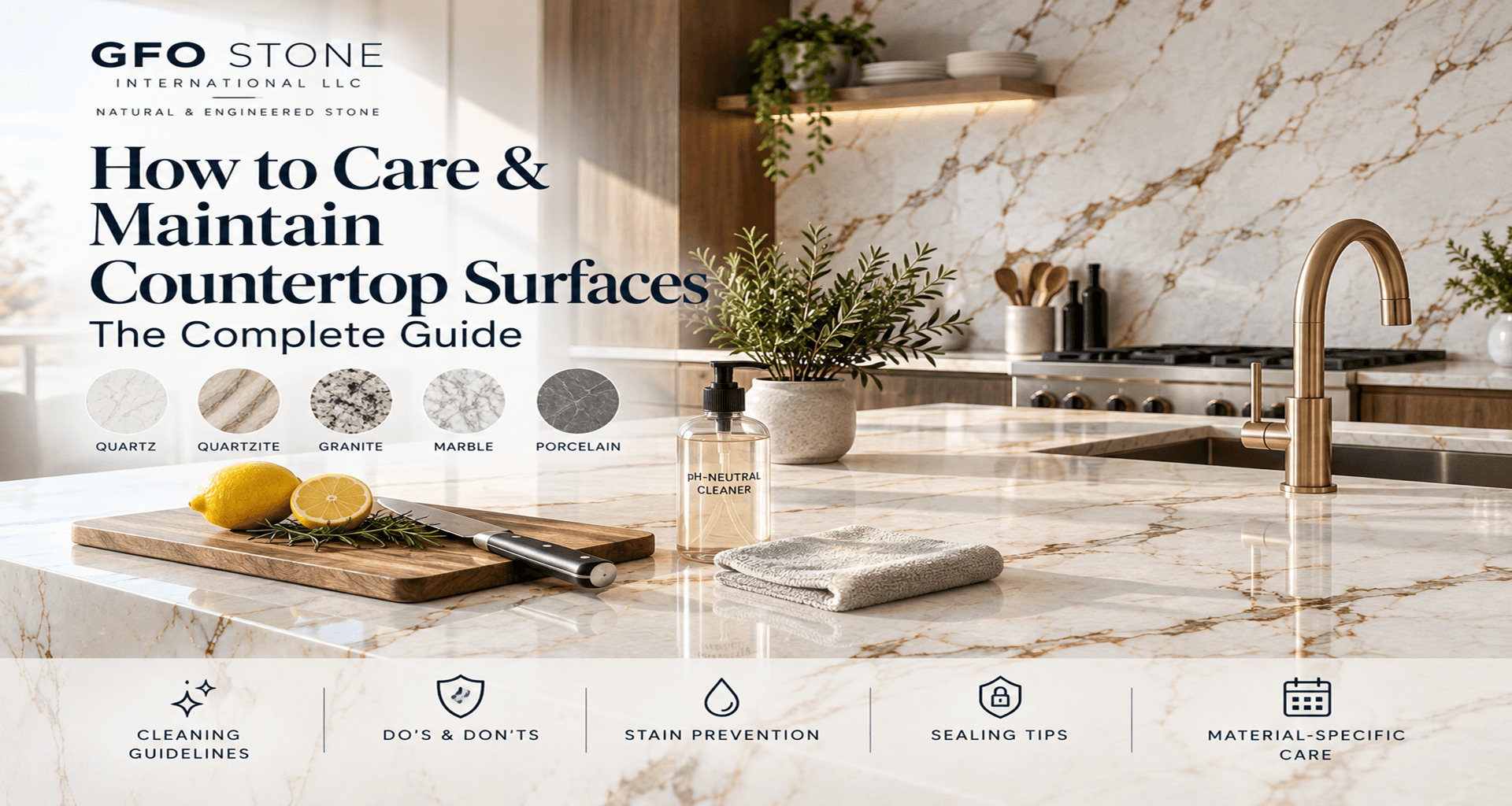
Countertop Care and Maintenance:
A beautiful countertop is an investment in both the appearance and functionality of a space. Whether the surface is Quartz, Quartzite, Granite, Marble, Porcelain, or another natural stone, proper countertop care can help preserve its finish and appearance for years to come. However, Countertop Care and Maintenance is not the same for every material. Engineered quartz has different care requirements from natural quartzite. Marble requires different precautions from granite, while porcelain has its own characteristics.
Understanding what to do—and what not to do—is essential for homeowners, designers, contractors, fabricators, property managers, and anyone responsible for maintaining finished countertop surfaces.
At GFO Stone, we supply Quartz, Quartzite, Granite, Marble, and Porcelain slabs to professional trade customers. This guide explains practical everyday care for each major countertop material.
> Important: This is general care guidance. Always follow the specific manufacturer's instructions for engineered products and the recommendations of the professional fabricator or installer for the actual installed surface.
The Basics of Countertop Care
Regardless of the countertop material, good everyday habits are one of the simplest ways to protect a finished surface.
For routine cleaning, start with a soft cloth or non-abrasive sponge, warm water, and a mild pH-neutral cleaner appropriate for the material.
Clean spills promptly rather than allowing liquids or food residue to remain on the surface.
Just as importantly, avoid assuming that because a countertop is durable, it is impossible to damage.
Countertop Care and Maintenance: What to Do
- Clean spills promptly.
- Use soft microfiber cloths or non-abrasive sponges.
- Use cleaners specifically appropriate for the countertop material.
- Use cutting boards when preparing food.
- Use trivets or heat-resistant pads beneath hot cookware.
- Use coasters beneath beverages when appropriate.
- Follow the fabricator's recommendations for sealing natural stone.
- Inspect natural stone periodically for changes in water absorption or finish.
- Protect countertop edges from heavy impacts.
- Keep the specific material and manufacturer's care information for future reference.
Countertop Care: What Not to Do
- Do not use abrasive pads or aggressive scouring powders unless specifically approved for the material.
- Do not use harsh chemicals without confirming compatibility.
- Do not cut directly on the countertop.
- Do not place extremely hot cookware directly on the surface.
- Do not allow spills to remain unnecessarily.
- Do not stand or sit on countertops.
- Do not drop heavy objects on countertop edges or corners.
- Do not assume all natural stones require identical maintenance.
- Do not assume quartz and quartzite are the same material.
- Do not use a cleaner simply because it is labeled "stone cleaner" without checking whether it is appropriate for your specific surface.
How to Care for Quartz Countertops
Quartz countertops are engineered surfaces made using mineral components combined with binders and other materials. Their relatively low-maintenance characteristics have made quartz a popular choice for residential kitchens, bathrooms, multifamily developments, and commercial applications.
Routine maintenance is generally straightforward.
Use warm water with a mild cleaner and a soft cloth for everyday cleaning. Wipe the surface clean and remove spills promptly.
Quartz generally does not require the periodic sealing associated with many natural stones.
However, low maintenance does not mean no precautions are necessary.
Quartz — Do
- Clean routinely with mild soap or an appropriate non-abrasive cleaner.
- Use a soft cloth or non-abrasive sponge.
- Wipe spills promptly.
- Use cutting boards.
- Use trivets or heat pads.
- Follow the specific quartz manufacturer's care instructions.
- Protect edges and corners from heavy impact.
Quartz — Don't
- Don't place hot pans, pots, or heated appliances directly on the quartz.
- Don't use the countertop as a cutting board.
- Don't use highly abrasive pads or powders.
- Don't expose the surface to aggressive chemicals or solvents unless specifically approved.
- Don't assume quartz is completely heat-proof.
- Don't attempt aggressive stain removal without checking the manufacturer's recommendations first.
If you're deciding between engineered quartz and natural quartzite, read Quartz vs. Quartzite: What's the Difference and Which Is Right for Your Project?.
How to Care for Quartzite Countertops
Quartzite is a natural stone valued for its geological character, veining, movement, and performance.
Because quartzite is natural, its characteristics can vary from one stone—and even one slab—to another.
For daily quartzite countertop care, use a soft cloth and a mild pH-neutral cleaner suitable for natural stone.
Spills should be cleaned promptly, particularly substances that could stain the stone.
Depending on the particular quartzite, finish, fabrication, and installation, sealing may be recommended. Your fabricator or stone-care professional should determine the appropriate sealing requirements.
Quartzite — Do
- Clean with a pH-neutral cleaner appropriate for natural stone.
- Wipe spills promptly.
- Use cutting boards.
- Use trivets beneath hot cookware.
- Ask your fabricator about sealing requirements.
- Use coasters beneath potentially staining beverages.
- Inspect the surface periodically.
- Follow professional recommendations for stain treatment.
Quartzite — Don't
- Don't assume every quartzite has identical absorption characteristics.
- Don't leave oils, wine, coffee, or other potentially staining substances on the surface unnecessarily.
- Don't use acidic or aggressive cleaners without confirming compatibility.
- Don't use abrasive cleaning products without professional guidance.
- Don't cut directly on the countertop.
- Don't place extremely hot cookware directly on the surface as a routine practice.
- Don't attempt aggressive DIY stain removal without identifying the type of stain and stone first.
Natural variation is one of quartzite's defining characteristics. Learn more in Why Quartzite Is One of the Most Sought-After Natural Stones in 2026.
How to Care for Granite Countertops
Granite has long been used for kitchen countertops because of its combination of natural beauty and durability.
Like quartzite, granite is natural stone, and individual materials can vary in porosity, mineral composition, and other characteristics.
For routine granite countertop maintenance, use warm water, a soft cloth, and a pH-neutral cleaner designed for natural stone.
Depending on the granite and installation, periodic sealing may be recommended.
Granite — Do
- Use a soft cloth or non-abrasive sponge.
- Use pH-neutral natural-stone cleaners.
- Clean spills promptly.
- Use cutting boards.
- Use trivets for hot cookware.
- Ask the fabricator about sealing.
- Keep oils and strongly colored liquids from sitting on the surface for extended periods.
- Have significant stains evaluated properly before treatment.
Granite — Don't
- Don't use highly acidic cleaners as routine cleaning products.
- Don't use harsh abrasive pads.
- Don't cut directly on the countertop.
- Don't ignore oil or strongly colored spills.
- Don't assume every granite has the same porosity.
- Don't reseal automatically without determining whether the surface actually needs it.
How to Care for Marble Countertops
Marble requires a different approach.
Its distinctive veining and classic appearance have made marble one of architecture's most recognizable natural materials, but it can be more sensitive to acids and certain types of surface wear than some other countertop materials.
Substances such as lemon juice, vinegar, and other acidic products can react with marble's calcium carbonate content and affect the finish. This is commonly known as etching.
An etch is different from a stain.
A stain involves a substance penetrating or discoloring the stone. An etch is a chemical change to the surface itself.
Understanding that difference is important when maintaining marble.
Marble — Do
- Clean spills immediately, particularly acidic liquids.
- Use pH-neutral cleaners specifically appropriate for marble.
- Use cutting boards.
- Use coasters beneath drinks.
- Use trivets beneath hot cookware.
- Ask the fabricator or stone professional about sealing requirements.
- Use soft cloths and non-abrasive cleaning tools.
- Have etching or significant staining evaluated by a stone-care professional when necessary.
Marble — Don't
- Don't clean marble with vinegar.
- Don't leave lemon or citrus juice on the surface.
- Don't use acidic bathroom or kitchen cleaners.
- Don't use abrasive scouring pads.
- Don't cut directly on the countertop.
- Don't confuse etching with staining.
- Don't assume sealing makes marble immune to etching.
- Don't use aggressive DIY treatments without understanding the stone and problem.
For customers who appreciate the character of natural stone, our Complete Guide to Natural Stone Slabs: From Quarry to Showroom explains why natural variation is an inherent part of materials such as marble, granite, and quartzite.
How to Care for Porcelain Countertops
Porcelain offers another option for contemporary countertops, backsplashes, wall applications, and other architectural surfaces.
Routine cleaning is generally straightforward. A soft cloth or non-abrasive sponge with an appropriate mild cleaner is suitable for everyday maintenance.
Although porcelain can offer strong resistance to many common household conditions, edges and corners can still be vulnerable to concentrated impact.
Porcelain — Do
- Clean routinely with a soft cloth or sponge.
- Remove spills and food residue promptly.
- Use cutting boards.
- Protect edges and corners from impact.
- Follow the manufacturer's specific care recommendations.
- Use appropriate cleaning products for the finished surface.
Porcelain — Don't
- Don't strike exposed edges with heavy cookware or objects.
- Don't use excessively abrasive cleaning tools.
- Don't cut directly on the countertop.
- Don't assume every porcelain product or finish has identical care requirements.
- Don't use aggressive chemicals without checking the manufacturer's instructions.
Stains vs. Etching: Know the Difference
One of the most common mistakes in countertop maintenance is treating every visible mark as a stain.
They are not necessarily the same.
A stain generally involves a substance penetrating or discoloring a surface.
Etching is a chemical reaction that alters the finish of acid-sensitive stone, particularly marble and other calcite-rich materials.
The correct treatment depends on what actually happened.
Applying a stain remover to an etched surface will not necessarily restore the finish because the issue is not simply discoloration.
If you are unsure whether a mark is a stain, etch, scratch, or another type of surface damage, consult a qualified stone-care professional before applying aggressive products.
Does Natural Stone Need to Be Sealed?
This question does not have one universal answer.
Natural stones vary significantly.
Some materials may benefit from penetrating sealers, while others may have relatively low absorption. The finish and actual stone characteristics also matter.
A sealer can help reduce the rate at which certain substances penetrate a porous stone, but sealing does not make natural stone stain-proof, scratch-proof, or etch-proof.
Follow the recommendations provided for the specific stone and installation.
Never Assume "Natural" Means Fragile
Natural stone has been used in architecture for centuries.
Proper care is less about treating a countertop as fragile and more about understanding the characteristics of the particular material.
Granite, Quartzite, and Marble are all natural stones, but they are not interchangeable.
Their mineral composition and physical characteristics differ.
That is why the best maintenance routine begins by knowing exactly what material is installed.
Countertop Care Quick Reference
| Surface | Routine Cleaning | Sealing | Main Precaution |
|---|---|---|---|
| Quartz | Mild cleaner + soft cloth | Generally not required | Protect from excessive/direct heat |
| Quartzite | pH-neutral stone cleaner | May be recommended | Spills, staining & material-specific care |
| Granite | pH-neutral stone cleaner | May be recommended | Spills & material-specific porosity |
| Marble | pH-neutral marble-safe cleaner | May be recommended | Acids, etching & staining |
| Porcelain | Mild appropriate cleaner | Follow manufacturer guidance | Protect edges from concentrated impact |
Protecting Countertops During Construction and Remodeling
Countertop care should begin before the project is finished.
During construction, countertops can be exposed to tools, paint, adhesives, construction dust, ladders, equipment, and materials that would not normally be placed on the surface.
Once countertops are installed:
- Protect them during remaining construction work.
- Don't use countertops as workbenches.
- Don't place power tools directly on finished surfaces.
- Don't stand on countertops to reach cabinets or ceilings.
- Don't drag equipment across the surface.
- Keep paint, adhesives, solvents, and construction chemicals away unless their compatibility has been confirmed.
- Protect exposed edges from impact.
A premium countertop can be damaged before the homeowner ever uses it if proper job-site precautions are not followed.
Choosing the Right Countertop Surface for Your Lifestyle
Maintenance should also be considered before selecting a countertop material.
A homeowner who wants minimal routine maintenance may evaluate the project differently from someone who specifically wants the natural character and patina associated with marble.
There is no single surface that is appropriate for every application.
Consider:
- Desired appearance
- Daily use
- Maintenance expectations
- Heat exposure
- Potential staining
- Natural variation
- Surface finish
- Project application
- Fabrication requirements
- Manufacturer or stone-care recommendations
Our How to Choose the Right Stone for a Kitchen Countertop guide provides a deeper comparison of Quartz, Quartzite, Granite, Marble, and Porcelain.
For projects involving oversized islands, full-height backsplashes, and waterfall panels, also see Large-Format & Jumbo Slabs: Why Slab Size Matters in Modern Design.
Explore Countertop Materials at GFO Stone
Proper maintenance starts with understanding the material you're working with.
GFO Stone supplies a diverse selection of Quartz, Quartzite, Granite, Marble, and Porcelain slabs for residential, multifamily, hospitality, and commercial projects.
As a B2B wholesale stone supplier and distributor, we work with:
- Fabricators
- Contractors
- Builders
- Developers
- Designers
- Architects
- Stone professionals
Contact GFO Stone Sales for B2B Pricing & Availability
GFO Stone supplies slabs to professional trade customers. We do not fabricate, cut, install, seal, repair, or provide countertop maintenance services.