Large-Format & Jumbo Quartz Slabs | GFO Stone
October 7, 2026
On this page
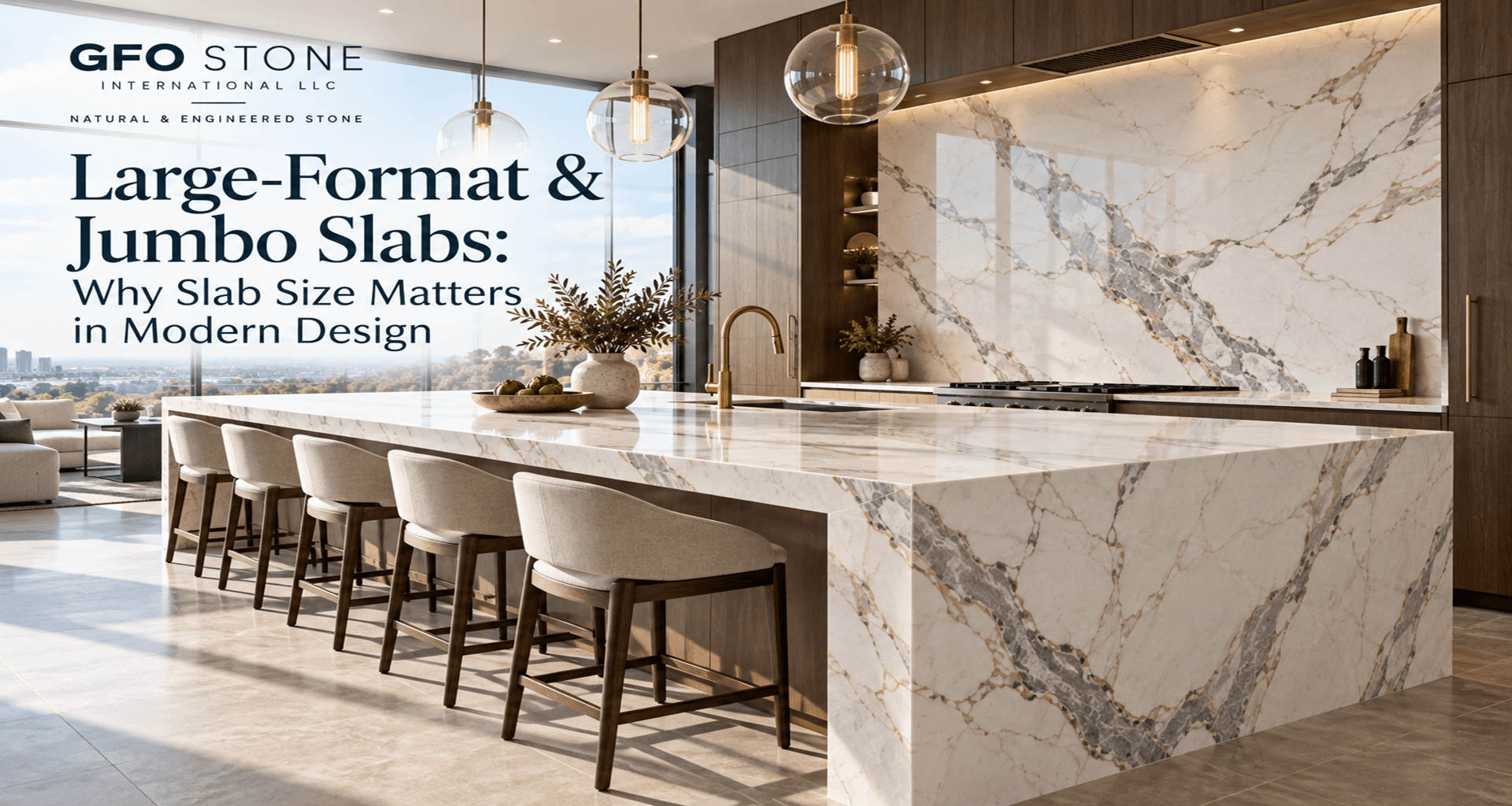
Modern kitchens are getting bigger, islands are becoming more ambitious, and designers are increasingly looking for uninterrupted surfaces with fewer seams. As a result, large-format, jumbo, and super-jumbo slabs have become increasingly important in residential, multifamily, hospitality, and commercial design.
But slab size is about more than creating a large countertop.
The dimensions of a slab can influence countertop layout, seam placement, material yield, fabrication planning, vein continuity, backsplash design, and the overall appearance of a finished space.
For fabricators, contractors, builders, designers, architects, and developers, understanding slab dimensions early in the specification process can help determine whether a material is appropriate for a particular project.
At GFO Stone, our Quartz collection includes standard, jumbo, and super-jumbo slab options, giving trade professionals greater flexibility when planning everything from large kitchen islands to multifamily developments.
Here is why slab size matters in modern design.
What Is a Jumbo Slab?
The stone and engineered-surface industry uses terms such as jumbo slab, super-jumbo slab, and large-format slab to describe materials produced in dimensions larger than conventional slabs.
There is not one universal dimension that applies to every manufacturer or product. Actual dimensions should always be verified for the specific material being considered.
Within the GFO Stone Quartz collection, slab dimensions vary by product.
For example, GFO Bianco Carrara Quartz GQ1002 is available in:
- Jumbo: 126 × 63 inches
- Super Jumbo: 138 × 68 inches
- Thickness: 2 cm and 3 cm
Other GFO Quartz designs are available in different dimensions, including popular formats around 130 × 65 inches.
For fabricators and project teams, those differences can significantly affect how a countertop is laid out and fabricated.
Why Slab Size Matters
Imagine a large kitchen island measuring approximately 10 feet long.
The countertop may look simple in a rendering, but the fabricator has to determine whether the selected slab can accommodate the required dimensions, edge details, cutouts, fabrication allowances, and pattern orientation.
If the slab is too small, the design may require an additional seam or another slab.
A larger slab can potentially provide more flexibility.
This is why countertop slab size should be considered during material selection, not after the design has already been finalized.
1. Large Kitchen Islands Need Large Slabs
The kitchen island has evolved into one of the most important architectural features of the modern home.
Today's islands may combine:
- Food preparation
- Seating
- Storage
- Sinks
- Cooktops
- Entertaining
- Dining
- Serving
- Integrated appliances
As islands become larger, countertop dimensions naturally increase.
A jumbo quartz slab or super-jumbo quartz slab may provide the fabricator with additional material to accommodate a larger island while optimizing the layout.
However, slab dimensions alone do not determine whether a countertop can be fabricated without seams. Fabrication allowances, edge profiles, cutouts, transportation, installation conditions, pattern orientation, and other project requirements must also be considered.
The fabricator should always determine the final layout.
For more guidance on choosing the material itself, see our How to Choose the Right Stone for a Kitchen Countertop guide.
2. Larger Slabs Can Help Reduce Seams
One of the most visible advantages of large-format material is the potential to reduce the number of seams in a countertop.
Seams are sometimes unavoidable and are a normal part of countertop fabrication.
However, when the selected slab provides enough usable surface area, a fabricator may have greater flexibility in determining where seams are necessary.
This can be particularly important for:
- Oversized kitchen islands
- Long countertop runs
- Commercial counters
- Reception desks
- Bar tops
- Conference surfaces
- Multifamily kitchens
Fewer seams can help create a cleaner visual appearance, particularly with quartz patterns designed to imitate continuous marble or natural-stone movement.
3. Jumbo Quartz Can Improve Pattern Continuity
Modern Quartz designs have become increasingly sophisticated.
Many feature large-scale veining inspired by marble and quartzite.
When a quartz design contains prominent veins, the size of the slab becomes part of the visual planning process.
A larger slab gives the fabricator more surface area from which to determine:
- Vein placement
- Pattern orientation
- Countertop positioning
- Island layout
- Backsplash sections
- Waterfall panels
- Seam locations
This can be particularly valuable with bold Calacatta-inspired quartz designs.
Instead of treating the slab simply as raw material, the fabricator and designer can consider the entire slab as part of the composition.
4. Large-Format Slabs Are Ideal for Waterfall Islands
A waterfall island extends the countertop material vertically down one or both sides of the island.
The effect can transform the island from a countertop into a larger architectural feature.
Large-format quartz can provide additional flexibility when planning the horizontal countertop and vertical waterfall panels.
For strongly veined quartz, careful slab layout can also help create a visual relationship between the top and vertical surfaces.
The result can make the stone pattern appear to flow through the design.
Achieving this effect requires careful planning by the fabricator, particularly when vein direction and pattern continuity are important.
5. Slab Size Matters for Full-Height Backsplashes
Countertops are not the only reason large slabs matter.
Full-height stone and quartz backsplashes have become an important element in contemporary kitchen design.
Instead of introducing another backsplash material, designers may continue the countertop surface vertically onto the wall.
This creates a coordinated visual statement between the countertop and backsplash.
Large-format slabs can give fabricators additional flexibility when planning material for:
- Countertops
- Full-height backsplashes
- Range walls
- Waterfall panels
- Shelves
- Other coordinating surfaces
When the countertop and backsplash use the same quartz design, careful slab planning can help create a more cohesive appearance.
6. Jumbo Slabs Can Improve Material Yield
For professional fabricators, slab size is also about efficiency.
Every project requires a slab layout.
The fabricator must determine how individual countertop pieces can be positioned within the available slab dimensions.
This process is often referred to as material yield.
A larger slab may provide more layout possibilities and allow fabricators to position multiple project components within a single slab.
For example, one slab may potentially accommodate combinations of:
- Countertop runs
- Island sections
- Vanity tops
- Backsplash pieces
- Waterfall panels
- Smaller project components
Actual yield depends on the project dimensions, pattern, cutouts, fabrication requirements, and slab characteristics.
A larger slab does not automatically mean less waste, but it can provide additional layout flexibility.
7. Slab Size Is Important for Multifamily Projects
Large-format quartz becomes especially relevant when moving from an individual kitchen to dozens or hundreds of units.
Multifamily projects require consistency, predictable specifications, material availability, and efficient fabrication.
For developers, contractors, fabricators, and architects, important questions include:
- What slab dimensions are available?
- What thickness is required?
- How many units are involved?
- What is the countertop configuration?
- How many pieces can potentially be fabricated from each slab?
- How consistent is the pattern?
- What quantity is currently available?
- Can additional material be sourced if required?
The answers can affect purchasing, fabrication planning, material yield, and project scheduling.
GFO Stone has supplied quartz for large residential and multifamily developments. Trade professionals can explore GFO Stone Real Projects to see materials used across completed projects.
8. Quartz Is Well Suited to Repetitive Project Specifications
For projects requiring many kitchens or bathrooms with similar layouts, engineered quartz offers an important characteristic: greater visual consistency than highly variable natural stone.
Because quartz is manufactured, the general design can be reproduced across multiple slabs.
That makes GFO Quartz particularly useful for projects where multiple units need a coordinated appearance.
When combined with jumbo or super-jumbo slab formats, project teams can evaluate both visual consistency and fabrication efficiency.
This can be valuable for:
- Multifamily developments
- Apartment buildings
- Condominiums
- Hospitality projects
- Student housing
- Senior living
- Commercial developments
9. Large Slabs Support Minimalist Design
Modern interior design often emphasizes simplicity.
Large uninterrupted surfaces, integrated backsplashes, long horizontal lines, concealed storage, and restrained material palettes can create a clean architectural appearance.
Large-format slabs support this design language.
A substantial quartz island with controlled veining can become the focal point of an otherwise minimal kitchen.
Instead of adding multiple decorative materials, the countertop itself provides visual interest.
This approach works especially well with white and neutral quartz patterns featuring broad Calacatta- or Carrara-inspired movement.
10. Super-Jumbo Quartz Creates More Design Flexibility
A super-jumbo slab does not simply mean “more countertop.”
The additional surface area can provide designers and fabricators with greater flexibility when considering complex layouts.
Potential applications include:
- Oversized islands
- Long countertop runs
- Waterfall edges
- Full-height backsplashes
- Commercial counters
- Reception desks
- Bar surfaces
- Large bathroom vanities
- Feature surfaces
For highly visible projects, this flexibility can allow the fabricator to make more deliberate decisions about where individual portions of the quartz pattern appear.
11. Slab Dimensions Should Be Verified Before Specification
One of the most important rules when working with jumbo slabs is simple:
Never assume every quartz design is available in the same slab size.
Dimensions can vary by product, manufacturer, collection, thickness, and current inventory.
A designer may select a quartz pattern based on appearance only to discover later that its available dimensions do not work efficiently with the proposed island or countertop layout.
Before finalizing a specification, confirm:
- Actual slab length
- Actual slab width
- Available thickness
- Current inventory
- Required quantity
- Project dimensions
- Fabrication requirements
- Pattern direction
- Lot or production considerations where applicable
Early verification can help reduce redesigns later in the project.
12. Thickness Matters Too
Slab length and width receive most of the attention, but thickness is another important specification.
GFO Stone carries quartz products in 2 cm and 3 cm, depending on the individual design and format.
Thickness can influence:
- Finished appearance
- Edge design
- Weight
- Handling
- Fabrication
- Support requirements
- Project specifications
The appropriate thickness should be determined based on the specific application and fabrication requirements.
13. Jumbo Quartz vs. Natural Stone Slabs
Natural stone and engineered quartz should not be evaluated in exactly the same way.
Natural Quartzite, Marble, and Granite slabs are cut from quarried blocks. Their dimensions are influenced by the size and characteristics of the original natural stone block.
Engineered quartz is manufactured, allowing slab formats to be produced to predetermined dimensions.
This manufacturing process makes jumbo and super-jumbo formats particularly useful when predictable slab dimensions are important to project planning.
Natural stone, however, provides geological variation and individuality that manufactured quartz is not intended to duplicate exactly.
To understand how natural slabs reach the warehouse, read The Complete Guide to Natural Stone Slabs: From Quarry to Showroom.
For a deeper comparison between natural quartzite and engineered quartz, see Quartz vs. Quartzite: What's the Difference and Which Is Right for Your Project?.
14. GFO Stone Jumbo & Super-Jumbo Quartz
GFO Stone offers a broad Quartz collection for fabricators, contractors, builders, designers, architects, developers, and other trade professionals.
Available dimensions depend on the individual product.
For example, GFO Bianco Carrara Quartz GQ1002 is available in both jumbo and super-jumbo formats:
- 126 × 63 inches — Jumbo
- 138 × 68 inches — Super Jumbo
- 2 cm and 3 cm thicknesses
Other GFO Quartz products are available in formats such as 130 × 65 inches, giving fabricators and project teams multiple options when evaluating material for kitchens, bathrooms, multifamily developments, and commercial applications.
Always verify current slab dimensions, thickness, and inventory with your GFO Stone representative before finalizing a project specification.
15. Choosing the Right Slab Size for Your Project
The largest available slab is not automatically the right slab.
The objective is to select a material and format that work with the actual project.
Before selecting a jumbo or super-jumbo slab, consider:
- Finished countertop dimensions
- Island size
- Required seams
- Pattern direction
- Vein placement
- Backsplash requirements
- Waterfall panels
- Fabrication yield
- Transportation
- Installation access
- Material quantity
- Available inventory
- Project budget
A fabricator should ultimately determine how the slab will be cut and whether the selected dimensions are appropriate for the installation.
Why Slab Size Matters More Than Ever
Modern design increasingly asks countertop materials to do more.
The countertop may continue up the wall as a backsplash.
An island may extend more than 10 feet.
Stone may wrap vertically down the sides of cabinetry.
A single quartz pattern may connect countertops, backsplashes, vanities, and other surfaces throughout a project.
As these applications become larger and more integrated, slab dimensions become an important part of the design itself.
Jumbo and super-jumbo quartz give fabricators, designers, architects, contractors, and builders additional flexibility to respond to these requirements.
The result is not simply a bigger slab.
It is a larger design canvas.
Explore Jumbo & Super-Jumbo Quartz at GFO Stone
GFO Stone is a B2B wholesale stone slab supplier and distributor serving fabricators, contractors, builders, developers, designers, architects, and other stone professionals.
Our Quartz collection includes a wide variety of colors and patterns, with jumbo and super-jumbo options available on select products.
Whether you are sourcing quartz for a large kitchen island, custom residence, multifamily development, hospitality project, or commercial application, our team can help you review:
- Available quartz designs
- Jumbo slab dimensions
- Super-jumbo slab dimensions
- 2 cm and 3 cm options
- Current inventory
- Quantity requirements
- Project-specific material needs
Explore GFO Stone Quartz Slabs
Contact GFO Stone Sales for B2B Pricing & Availability
GFO Stone is a wholesale stone supplier and distributor. We do not fabricate, cut, or install countertops.