Natural Stone Slabs: From Quarry to Showroom | GFO Stone
September 25, 2026
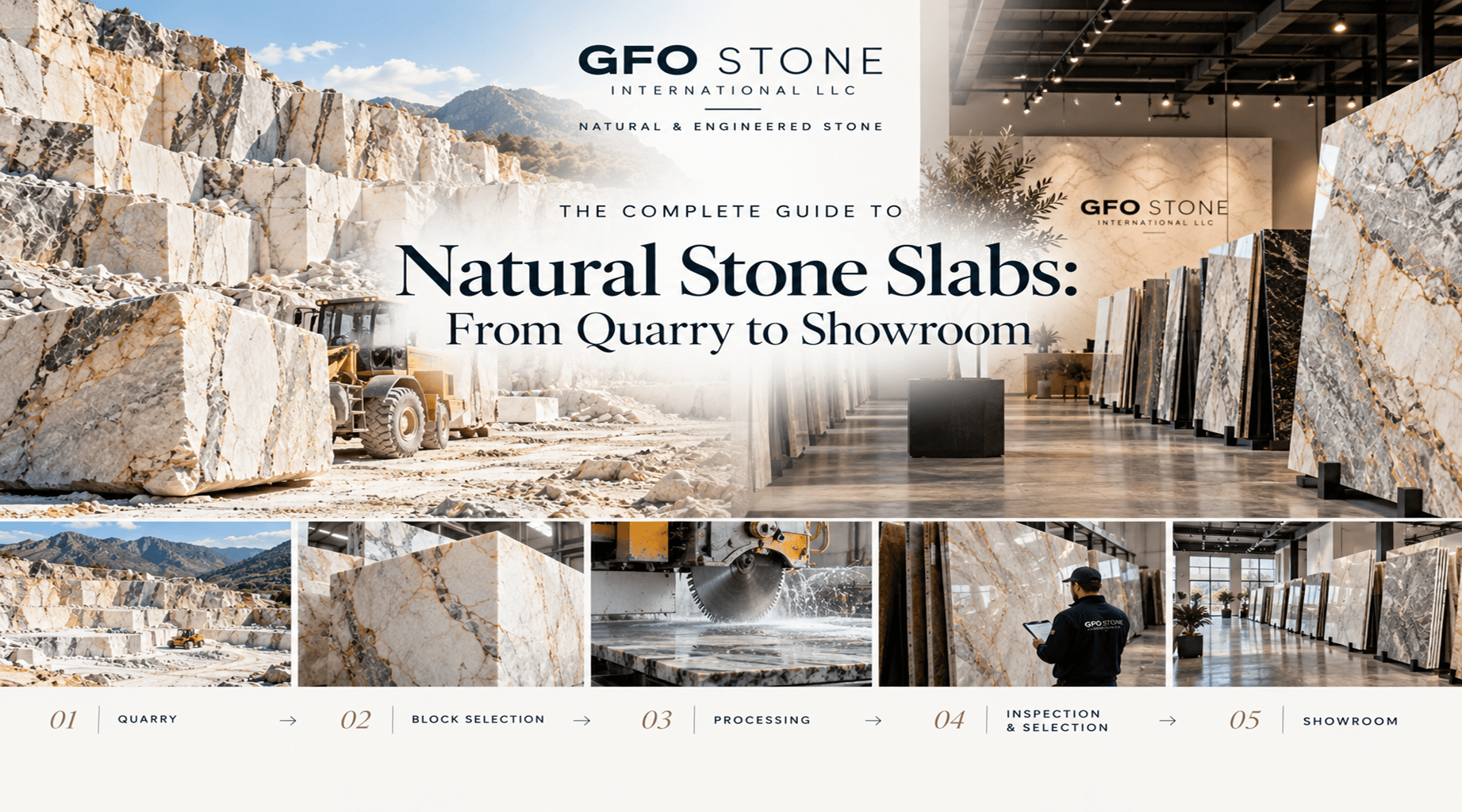
The Complete Guide to Natural Stone Slabs: From Quarry to Showroom
All natural stone slabs have a story that began millions of years before it reached a kitchen, bathroom, hotel, or commercial project.
Before a slab of Quartzite, Marble, Granite, Travertine, Limestone, Onyx, or Soapstone reaches a GFO Stone showroom, it passes through a remarkable journey—from geological formation and natural stone quarrying to block selection, slab cutting, finishing, inspection, international transportation, and final slab selection.
Understanding how natural stone slabs are made helps fabricators, contractors, designers, architects, builders, and other stone professionals appreciate why every slab is different—and why selecting the actual slab is such an important part of working with natural stone.
As a natural stone slab supplier and importer, GFO Stone sources natural stone from suppliers and producers in more than 15 countries worldwide. Here is a closer look at the fascinating stone quarry-to-countertop journey and how raw stone becomes the premium slabs found in our showrooms.
1. How Natural Stone Slabs Begin
Natural stone begins beneath the earth's surface, where geological processes create materials with characteristics that cannot be manufactured exactly.
Different geological conditions produce different types of stone.
Granite forms primarily from slowly cooled magma beneath the earth's surface.
Marble develops when limestone undergoes heat and pressure, transforming its mineral structure.
Quartzite begins primarily as quartz-rich sandstone that is transformed through heat and pressure into a dense metamorphic rock.
Travertine and limestone form through sedimentary processes, while other natural stones develop under their own specific geological conditions.
These processes create the colors, minerals, crystalline structures, veins, movement, and other characteristics visible in finished natural stone slabs.
This geological origin is why every piece of natural stone is inherently unique.
2. How Natural Stone Is Quarried
The commercial journey of a natural stone slab begins at the quarry.
Natural stone quarries are selected based on the geological deposits available at a particular location. Some quarries produce stone with relatively consistent characteristics, while others contain significant variations in color, veining, and movement.
Rather than removing finished slabs directly from the ground, quarry operations extract enormous sections of natural stone known as blocks.
Depending on the stone and quarry, specialized equipment may include:
- Diamond wire saws
- Drilling equipment
- Excavators
- Loaders
- Hydraulic equipment
- Specialized cutting machinery
The goal is to separate large stone blocks from the deposit while preserving as much usable natural material as possible.
Understanding how natural stone is quarried also helps explain why slab sizes, characteristics, availability, and production can vary from one material to another.
Quarrying requires considerable planning because fractures, mineral structures, geological movement, and other natural conditions can influence how a block can be extracted.
3. From Quarry Face to Natural Stone Block
Once separated from the quarry face, a natural stone block can weigh many tons.
Heavy equipment moves the blocks from the extraction area to locations where they can be inspected, classified, and prepared for transportation or processing.
At this stage, experienced stone professionals examine characteristics such as:
- Background color
- Veining
- Mineral composition
- Pattern
- Block dimensions
- Visible fractures
- Structural characteristics
- Overall appearance
Not every section of a quarry produces identical material.
Even blocks extracted relatively close to one another can contain noticeable differences.
This natural variation ultimately contributes to the individuality of the granite slabs, marble slabs, and quartzite slabs produced from each block.
4. Natural Stone Block Selection
Block selection is one of the most important stages in the natural stone supply process.
Before a block becomes slabs, buyers and processors evaluate whether its appearance and physical characteristics are appropriate for the intended market.
For highly decorative stones, the exterior of the block may provide only a limited indication of what will appear after cutting.
The real character of the natural stone is often revealed when the block is opened.
Inside, the stone may display dramatic veins, crystalline formations, subtle color transitions, fossils, mineral deposits, or entirely unexpected patterns.
This element of discovery is one of the characteristics that makes working with natural stone different from manufactured surfaces such as Quartz and Porcelain.
5. Transporting Natural Stone Blocks to the Processing Facility
After selection, stone blocks are transported to specialized processing facilities.
Because of their extraordinary weight and size, moving natural stone blocks requires heavy-duty transportation and handling equipment.
At the processing facility, the blocks are prepared to be transformed into slabs.
Depending on the material, market requirements, and processing method, a single large block can produce numerous natural stone slabs that share related geological characteristics.
These slabs are often sequential, meaning adjacent slabs may display continuing patterns or movement.
That relationship can become especially important for projects requiring multiple coordinated marble, granite, or quartzite slabs.
6. How Natural Stone Blocks Are Cut Into Slabs
The next major step in the quarry-to-countertop process occurs when the stone block is cut.
Specialized stone-processing machinery cuts the massive block into individual slabs of predetermined thickness.
Depending on the stone and processing facility, equipment may include gang saws, multi-wire machines, or other specialized cutting systems.
As each cut is made, the interior character of the natural stone is revealed.
This is the moment when a rough quarry block begins to become the recognizable natural stone slabs seen in stone warehouses and showrooms.
Veins can suddenly stretch across an entire slab.
Colors hidden inside the block become visible.
Mineral formations and crystalline areas emerge.
No digital rendering or small sample can completely recreate the experience of seeing a full natural stone slab for the first time.
7. Natural Stone Slab Thickness
Natural stone slabs are produced in different thicknesses depending on the material, processing facility, and intended market.
Common slab thicknesses used within the stone industry include approximately:
- 2 cm
- 3 cm
- 5 cm
Slab thickness can influence fabrication, handling, edge design, weight, support requirements, and the overall finished appearance.
Fabricators should always verify the actual dimensions and thickness of selected quartzite slabs, marble slabs, or granite slabs before planning fabrication.
8. Natural Stone Slab Reinforcement and Preparation
After cutting, some natural stone slabs undergo additional preparation.
Depending on the material and its natural characteristics, this can include reinforcement processes designed to support the slab during transportation, fabrication, or handling.
Certain materials may receive resin treatment or mesh reinforcement on the back.
These processes do not eliminate the natural characteristics of the stone. They are part of preparing particular materials for commercial slab applications.
The exact processing requirements vary considerably by stone.
9. Natural Stone Slab Finishes
Freshly cut stone does not necessarily have the finished appearance customers see in a stone slab showroom.
The surface typically undergoes additional processing to achieve its desired finish.
One of the most familiar finishes is polished, which creates a smooth surface and can emphasize color, depth, veining, and mineral characteristics.
Other natural stone finishes may include:
- Honed
- Leathered
- Brushed
- Satin
- Textured
- Other specialty finishes
The same natural stone can look noticeably different depending on the finish.
A polished finish may emphasize depth and reflection, while a honed or leathered surface can create a softer or more textured appearance.
Finish selection should therefore be considered part of the overall design—not simply a technical specification.
10. Natural Stone Slab Inspection and Selection
Once processing is complete, individual slabs can be inspected.
This stage is especially important when GFO Stone evaluates natural stone slabs for its inventory.
Stone selection involves much more than identifying a popular material name.
The actual slabs matter.
Factors considered can include:
- Overall appearance
- Color
- Veining
- Movement
- Finish quality
- Slab dimensions
- Thickness
- Structural characteristics
- Slab-to-slab relationship
- Market demand
- Potential applications
For premium natural stone, experienced selection can make a significant difference in the material ultimately offered by a natural stone importer and supplier.
11. Why Every Natural Stone Slab Is Different
Natural stone should never be treated like a manufactured pattern.
Even slabs cut sequentially from the same block can contain differences.
Natural variation can include:
- Veining
- Tint
- Density
- Mineral deposits
- Crystalline areas
- Background color
- Pattern intensity
- Natural fissures
- Movement
These characteristics are inherent to natural stone.
A sample can provide a useful representation of the general material, but it cannot guarantee the exact appearance of another slab.
This is one of the reasons GFO Stone encourages customers to inspect and approve natural stone slabs before fabrication.
12. Preparing Natural Stone Slabs for International Transportation
Many natural stone slabs travel thousands of miles before reaching the United States.
After processing and inspection, slabs must be carefully prepared for international transportation.
They may be secured into specialized bundles or frames designed for heavy stone transportation.
Proper handling is critical.
A single natural stone slab can weigh hundreds of pounds, while a complete bundle can weigh several tons.
From the processing facility, slabs may travel by truck to a port, by ocean freight to the United States, and then by truck again to their destination warehouse.
This international supply chain connects quarries and processing facilities around the world with natural stone importers, wholesale stone slab suppliers, fabricators, contractors, designers, architects, and builders.
13. Natural Stone Slabs From Around the World
One of the remarkable characteristics of the natural stone industry is its global diversity.
Different regions of the world are known for distinctive geological formations and stone varieties.
As a natural stone importer and wholesale stone slab supplier, GFO Stone works with suppliers and producers in more than 15 countries worldwide, allowing us to offer a diverse collection of natural stone.
Our natural stone collection includes:
Each stone category—and often each individual quarry—offers its own colors, patterns, mineral characteristics, and geological story.
14. Natural Stone Slabs Arrive at GFO Stone
When natural stone arrives at a GFO Stone warehouse, the quarry-to-showroom journey is not quite finished.
Incoming slabs must be received, handled, organized, and prepared for trade customers to view.
Natural stone slabs are stored using systems designed specifically for the weight and dimensions of stone.
Inventory information allows the GFO Stone team to identify available materials and help fabricators, contractors, designers, architects, and builders locate slabs appropriate for their projects.
From subtle neutral stones to dramatic exotic quartzites, the warehouse becomes a library of natural geology from around the world.
Trade professionals can explore the broader GFO Stone product collection to compare natural and engineered materials for upcoming projects.
15. From Natural Stone Warehouse to Slab Showroom
The stone slab showroom and selection experience connects the global stone supply chain with the individual project.
This is where designers, contractors, fabricators, builders, and their customers can experience natural stone at full scale.
Viewing a full slab makes it possible to evaluate characteristics that may not be apparent from a small sample or online photograph.
These include:
- Overall slab movement
- Vein direction
- Color transitions
- Mineral formations
- Pattern scale
- Areas of visual interest
- Relationship between multiple slabs
- Potential countertop layout
For natural stone, seeing the actual slab can significantly change the selection process.
Trade customers can visit a GFO Stone showroom to view available quartzite slabs, marble slabs, granite slabs, and other natural stone in person.
16. Why Viewing a Full Natural Stone Slab Matters
Imagine selecting Taj Mahal Quartzite from a small sample.
The sample might show a cream background and a small section of warm veining.
A full Taj Mahal Quartzite slab, however, could reveal sweeping movement stretching from one side to another, subtle gold areas, changes in background tone, and veins that could become the defining feature of a kitchen island.
The same principle applies to dramatic materials such as Crystallo Quartzite, Fusion Quartzite, Illusion Blue Quartzite, marble, granite, and other natural stones.
The full slab tells the complete visual story.
For more guidance on selecting quartzite and understanding current design trends, explore Why Quartzite Is One of the Most Sought-After Natural Stones in 2026.
17. Natural Stone Slab Selection for Large Projects
Natural stone slab selection becomes even more important when multiple slabs are required.
For a large residential kitchen, hospitality project, commercial space, or multifamily development, project teams should consider:
- Required quantity
- Available slab dimensions
- Slab thickness
- Sequential slabs
- Color consistency
- Vein direction
- Layout requirements
- Fabrication yield
- Current inventory
- Potential future availability
- Project schedule
Material availability should be verified early in the project, especially when a specific natural stone appearance is required.
For commercial and multifamily projects requiring larger quantities of wholesale stone slabs, early coordination between the stone supplier, fabricator, designer, architect, builder, and contractor can help identify potential material requirements before fabrication begins.
Designers, architects, builders, and developers can also explore GFO Stone Real Projects to see how GFO materials have been used in residential, multifamily, hospitality, and commercial applications.
18. From Natural Stone Slab to Countertop: The Fabricator's Role
After the stone has been selected, the next stage of the stone quarry-to-countertop journey belongs to the professional fabricator.
The fabricator transforms the natural stone slab into the finished architectural surface.
Depending on the project, fabrication may involve:
- Digital measurements or templates
- Slab layout
- Cutting
- Sink and cooktop cutouts
- Edge fabrication
- Seam preparation
- Surface finishing
- Transportation
- Installation
Fabrication decisions can have a major impact on how the natural pattern appears in the finished project.
This is why communication among the customer, designer, contractor, fabricator, and stone slab supplier is so important.
GFO Stone does not fabricate, cut, or install stone.
We are a B2B stone supplier and distributor providing natural and engineered slabs to professional trade customers who manage fabrication and installation.
19. From Quarry to Countertop
Consider the complete journey of a quartzite kitchen island.
The quartzite began as geological material formed naturally over immense periods of time.
It was discovered within a quarry.
A massive stone block was extracted.
The block was selected and transported to a processing facility.
It was cut into quartzite slabs.
The slabs were finished and inspected.
Selected material was prepared for international shipping.
It crossed oceans and traveled by truck.
It arrived at a natural stone warehouse.
A fabricator, contractor, designer, or customer selected the slab.
The professional fabricator then transformed that raw natural stone slab into a finished countertop.
What appears to be a countertop is actually the final stage of a much larger quarry-to-countertop journey.
If you're comparing materials for an upcoming kitchen project, our How to Choose the Right Stone for a Kitchen Countertop guide explains the differences between quartz, quartzite, granite, marble, and porcelain.
Why Natural Stone Slabs Remain Unique
Technology can manufacture increasingly sophisticated surfaces, but natural stone remains fundamentally different.
It is not printed.
Its geological pattern was not designed on a computer.
Its veins were not placed according to a template.
Its mineral formations developed naturally.
Every block reveals something different, and every slab captures a section of geological history.
That authenticity is one of the reasons natural stone slabs continue to play an important role in residential architecture, commercial projects, hospitality spaces, and interior design.
For professionals comparing natural quartzite with engineered quartz, read Quartz vs. Quartzite: What's the Difference and Which Is Right for Your Project?.
GFO Stone: Natural Stone Importer & Wholesale Slab Supplier
At GFO Stone, our role in the quarry-to-showroom journey is to connect remarkable stone from around the world with the professionals who transform it into finished spaces.
As a natural stone importer and wholesale stone slab supplier, GFO Stone provides premium materials to:
- Stone fabricators
- Contractors
- Builders
- Developers
- Designers
- Architects
- Stone professionals
Whether you are sourcing a single statement slab for a luxury residence or evaluating wholesale natural stone slabs for a commercial, hospitality, or multifamily project, our team can help you review available inventory, slab dimensions, and material options.
Visit a GFO Stone Slab Showroom
A photograph can introduce you to a natural stone.
A sample can show you its color.
But a full slab reveals its true character.
Visit a GFO Stone showroom to explore natural stone slabs at full scale and discover the variation, movement, color, veining, and geological characteristics that make each slab unique.
Explore the GFO Stone Natural Stone Collection
Contact GFO Stone Sales for Wholesale Stone Slab Pricing & Availability
GFO Stone is a B2B wholesale stone supplier and distributor. We do not fabricate, cut, or install stone.