Why Quartzite Is Trending in 2026 | GFO Stone
September 18, 2026
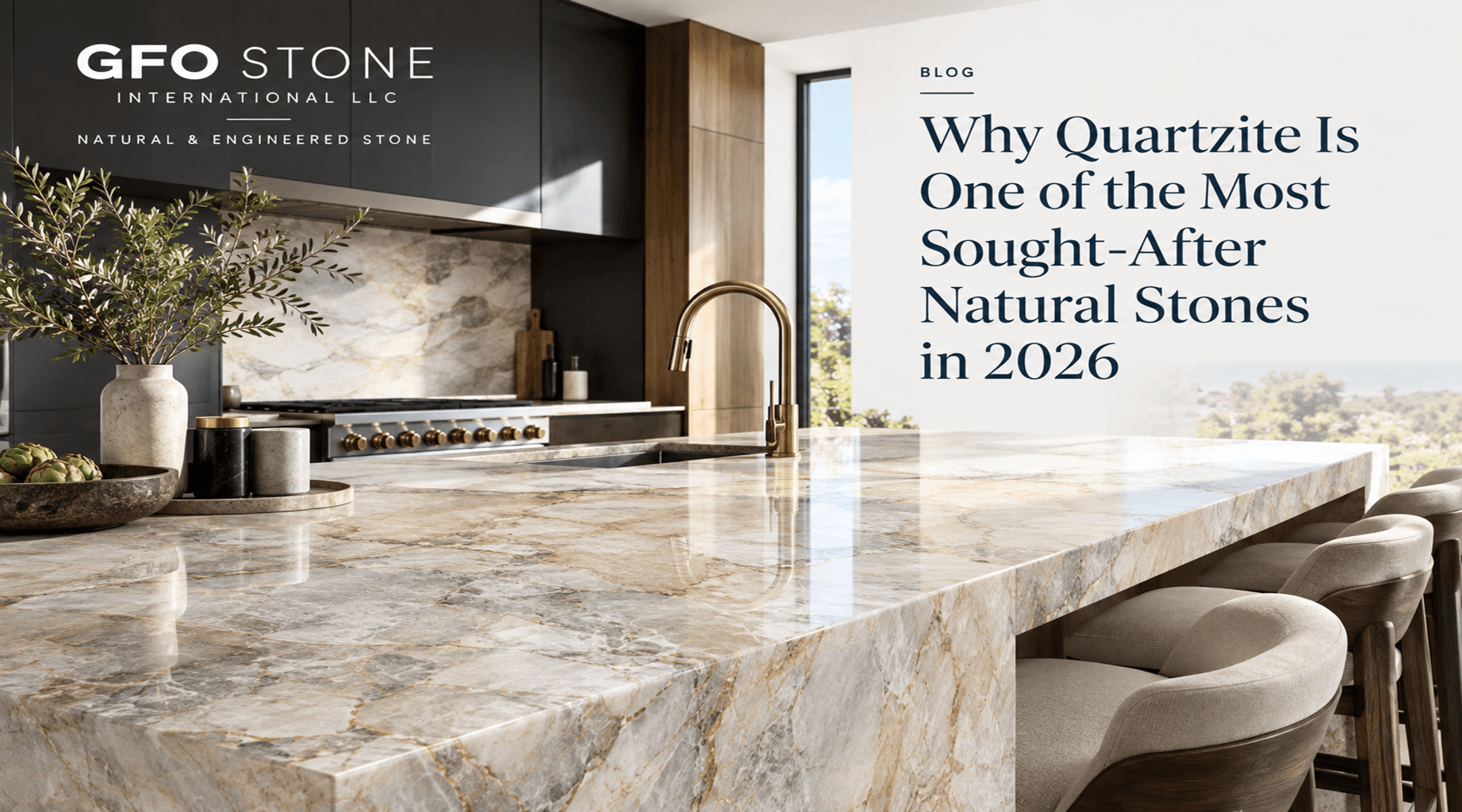
Why Quartzite Is One of the Most Sought-After Natural Stones in 2026
Quartzite has become one of the most talked-about natural stone materials in contemporary kitchen and interior design. Its combination of natural beauty, distinctive veining, depth, and stone character has made it a popular choice for designers, architects, builders, and homeowners looking for something beyond conventional countertop materials.
In 2026, the interest in quartzite continues to be reflected across the kitchen and bath industry. The National Kitchen & Bath Association's 2026 Kitchen Trends Report identified natural quartzite as the second-most selected countertop material among surveyed industry professionals, at 62%, behind quartz. Houzz has also identified quartzite and quartzite-inspired surfaces as a major 2026 design trend, particularly for their dramatic movement, warm tones, and natural appearance.
For GFO Stone's trade customers, quartzite represents more than a countertop trend. It is a natural material that can bring individuality and visual impact to residential, hospitality, multifamily, and commercial projects.
What Is Quartzite?
Quartzite is a natural metamorphic stone formed when quartz-rich sandstone is subjected to intense heat and pressure over geological time.
This natural formation process creates a material with distinctive mineral characteristics, movement, color variation, and veining. Unlike engineered materials, each quartzite slab can have its own appearance.
Depending on the stone, quartzite can feature:
- Soft white and cream backgrounds
- Gray and taupe movement
- Gold and warm beige veining
- Dramatic linear patterns
- Crystalline areas
- Subtle waves and flowing movement
- Bold contrasting veins
These natural characteristics are a major part of quartzite's appeal.
Why Is Quartzite So Popular in 2026?
Several design trends are contributing to the continued interest in quartzite.
Today's kitchens are increasingly incorporating natural materials, warmer neutral palettes, natural wood tones, and surfaces with visual movement. NKBA's 2026 report identified organic and natural design as a growing direction, while its materials findings placed natural quartzite immediately behind quartz among countertop materials.
Houzz's 2026 coverage similarly points to warm neutrals, expressive natural materials, and quartzite-inspired surfaces as significant design directions.
Together, these trends help explain why quartzite has become such a prominent material for high-end interiors.
1. Natural Beauty That Cannot Be Reproduced Exactly
One of the biggest attractions of quartzite is that it is genuinely natural stone.
Every slab develops its own geological character. Veining, mineral deposits, color transitions, and movement can vary from one slab to another.
This gives designers an opportunity to create spaces that feel individual rather than mass-produced.
For a kitchen island, fireplace wall, bathroom vanity, or feature wall, the stone itself can become an architectural focal point.
2. Dramatic Veining and Movement
One of the defining characteristics of today's popular quartzites is movement.
Rather than completely uniform surfaces, many contemporary quartzites feature flowing veins and layered patterns that move across the slab.
This can create a particularly strong visual effect when the material is used on:
- Large kitchen islands
- Waterfall countertops
- Full-height backsplashes
- Bathroom vanities
- Fireplace surrounds
- Feature walls
- Hospitality spaces
The popularity of expressive natural stone also reflects a broader 2026 design direction toward materials with variation, texture, and authenticity.
3. Warm Neutrals Are Shaping Kitchen Design
White and cool gray surfaces have dominated kitchen design for years, but 2026 is seeing greater interest in warmer neutrals.
Cream, ivory, beige, taupe, soft gray, and warm gold tones are increasingly being paired with natural wood cabinetry and organic materials.
Quartzites with warm backgrounds and subtle gold, beige, or gray veining fit naturally into this design direction.
This is one reason materials inspired by the look of Taj Mahal Quartzite have become particularly prominent in contemporary kitchens. Houzz specifically highlighted Taj Mahal-inspired surfaces and warm neutral quartzite looks in its 2026 surface trends coverage.
4. Quartzite Works With Modern and Traditional Design
Quartzite is not limited to one architectural style.
Its natural character can complement:
- Contemporary kitchens
- Modern luxury interiors
- Transitional homes
- European-inspired kitchens
- Organic modern interiors
- Traditional kitchens
- Hospitality spaces
- High-end multifamily interiors
A softly veined quartzite can create a calm and understated appearance, while a dramatic stone can become the primary focal point of the room.
This flexibility makes quartzite particularly useful for designers working across different project styles.
5. Large Slabs Create Greater Design Opportunities
Large kitchen islands have become an important part of modern kitchen design.
As islands become larger and increasingly serve as gathering, preparation, dining, and entertaining spaces, the countertop becomes one of the most visible surfaces in the room.
Large-format and jumbo slabs can provide designers and fabricators with greater layout flexibility.
For heavily veined quartzite, slab size is especially important because it allows the natural movement of the stone to be considered across the entire design.
Before specifying a material, fabricators should verify the actual slab dimensions and determine how the slabs will be laid out.
6. Quartzite Can Become the Centerpiece of a Kitchen
A major design trend in 2026 is allowing statement materials to take center stage.
Minimal cabinetry and restrained finishes can provide a backdrop for a dramatic stone island or backsplash.
This approach works particularly well with quartzite.
Instead of competing with the stone, cabinetry, hardware, lighting, and flooring can be selected to complement the natural movement of the slab.
The result can be a kitchen where the stone provides the visual identity of the space.
7. Quartzite Extends Beyond the Kitchen
Although quartzite is strongly associated with luxury kitchens, its design potential extends much further.
It can be considered for:
- Bathroom countertops
- Double vanities
- Shower features
- Fireplace surrounds
- Feature walls
- Hospitality interiors
- Reception areas
- Commercial interiors
- Custom furniture and architectural surfaces
The same natural characteristics that make quartzite effective on a kitchen island can create a dramatic statement in other areas of a project.
8. Popular Quartzite Looks in 2026
There is no single “quartzite look.”
Different stones offer dramatically different aesthetics.
Taj Mahal Quartzite
Taj Mahal is known for its warm, elegant appearance, typically combining creamy backgrounds with soft beige, taupe, and subtle gold movement.
It works particularly well with warm wood cabinetry, brass or bronze hardware, and neutral interiors.
Super White Quartzite
Super White offers a lighter appearance with gray movement and veining.
It can work well in contemporary and transitional kitchens where designers want the visual depth of natural stone without an overly dramatic pattern.
Crystallo Quartzite
Crystallo is known for its luminous appearance and distinctive crystalline character.
It can create a high-impact statement in luxury kitchens, feature walls, and other applications where the natural character of the stone should be emphasized.
Mont Blanc Quartzite
Mont Blanc offers a softer neutral palette with elegant movement and veining.
Its understated character can complement modern, transitional, and organic-inspired interiors.
White Macaubas Quartzite
White Macaubas is recognized for its linear movement and elongated veining.
Its directional pattern can create an especially striking appearance when the slab layout is carefully considered.
Fusion Quartzite
Fusion offers a much more dramatic aesthetic, combining deeper tones and complex natural movement.
It can be used when the stone is intended to become the primary visual statement of the space.
9. Natural Variation Is Part of the Beauty
When selecting quartzite, it is important to understand that natural stone is not manufactured to look identical from slab to slab.
Variation may occur in:
- Color
- Veining
- Movement
- Mineral deposits
- Background tone
- Pattern intensity
- Density
This is not necessarily a flaw. It is part of what makes natural stone unique.
For high-end projects, GFO recommends reviewing the actual slabs whenever possible before fabrication.
The more prominent the stone will be in the design, the more important slab selection and layout become.
10. Slab Selection Should Happen Early
For designers, architects, builders, contractors, and fabricators, early material selection can make a significant difference.
Before finalizing the countertop design, consider:
- How many slabs are required?
- What slab dimensions are available?
- Is the desired material currently in stock?
- Will additional slabs be required?
- How will the slabs be oriented?
- Where will seams occur?
- Is bookmatching desired?
- How will the veins flow across the island?
- Does the material meet the project's fabrication requirements?
These questions become particularly important for large islands and projects using highly directional or dramatically veined quartzite.
Quartzite vs. Quartz: Why the Difference Matters
Quartz and quartzite are often confused because of their similar names, but they are fundamentally different materials.
Quartzite is natural stone.
Quartz is an engineered surface.
Quartz can provide highly controlled patterns and consistent production across slabs. Quartzite provides the natural variation, mineral character, and geological movement associated with natural stone.
The right material depends on the project.
For a broader comparison, see our guide to Quartz vs. Quartzite.
Is Quartzite a Good Choice for Kitchen Countertops?
Quartzite is widely used for kitchen countertops and islands, but the specific stone should always be evaluated for the intended application.
Before selecting a quartzite, consider:
- The characteristics of the specific stone
- The finish
- Fabrication requirements
- Maintenance requirements
- Slab dimensions
- Available quantity
- Project schedule
- Installation requirements
Natural stone performance can vary between materials, so project teams should review the applicable technical information and care recommendations for the specific quartzite being selected.
Why Designers and Fabricators Should View the Actual Slab
A small sample can show the general color of a quartzite, but it cannot always communicate the full pattern of a large slab.
The actual slab allows the design team to evaluate:
- Vein direction
- Movement
- Background color
- Pattern intensity
- Mineral characteristics
- Slab-to-slab variation
- Potential layout options
This is especially important for a large island or waterfall edge where the stone occupies a significant visual area.
Quartzite and the Future of Luxury Stone Design
The popularity of quartzite reflects a broader movement toward natural materials with character.
Rather than completely uniform surfaces, many current interiors are embracing natural variation, warm neutrals, organic materials, and expressive stone.
For 2026, industry research and design coverage point toward kitchens that feel more personalized, connected, warm, and natural. Quartzite fits naturally into that design direction because every slab can bring its own combination of color, movement, and geological character.
Explore Premium Quartzite at GFO Stone
At GFO Stone, we supply premium natural and engineered stone slabs to fabricators, contractors, designers, architects, builders, and other trade professionals.
Our quartzite collection includes a range of colors, patterns, and natural characteristics suitable for residential, multifamily, hospitality, and commercial projects.
Explore materials such as:
- Taj Mahal Quartzite
- Super White Quartzite
- Crystallo Quartzite
- Mont Blanc Quartzite
- White Macaubas Quartzite
- Fusion Quartzite
- Baykal Quartzite
Because natural stone is unique, availability and slab characteristics can change. Contact the GFO Stone sales team to review current inventory, slab dimensions, and project requirements.
GFO Stone is a stone supplier and distributor. We supply slabs to professional trade customers and do not fabricate, cut, or install stone.
Visit GFO Stone
Our team is available to help trade professionals evaluate natural and engineered stone for their next project.
Garfield, NJ Showroom
112 Monroe St.
(973) 601-4436
Bristol, PA Showroom
2924 Veterans Hwy
(215) 714-4436