How to Choose the Right Stone for a Kitchen Countertop | GFO Stone
September 10, 2026
On this page
How to Choose the Right Stone for a Kitchen Countertop
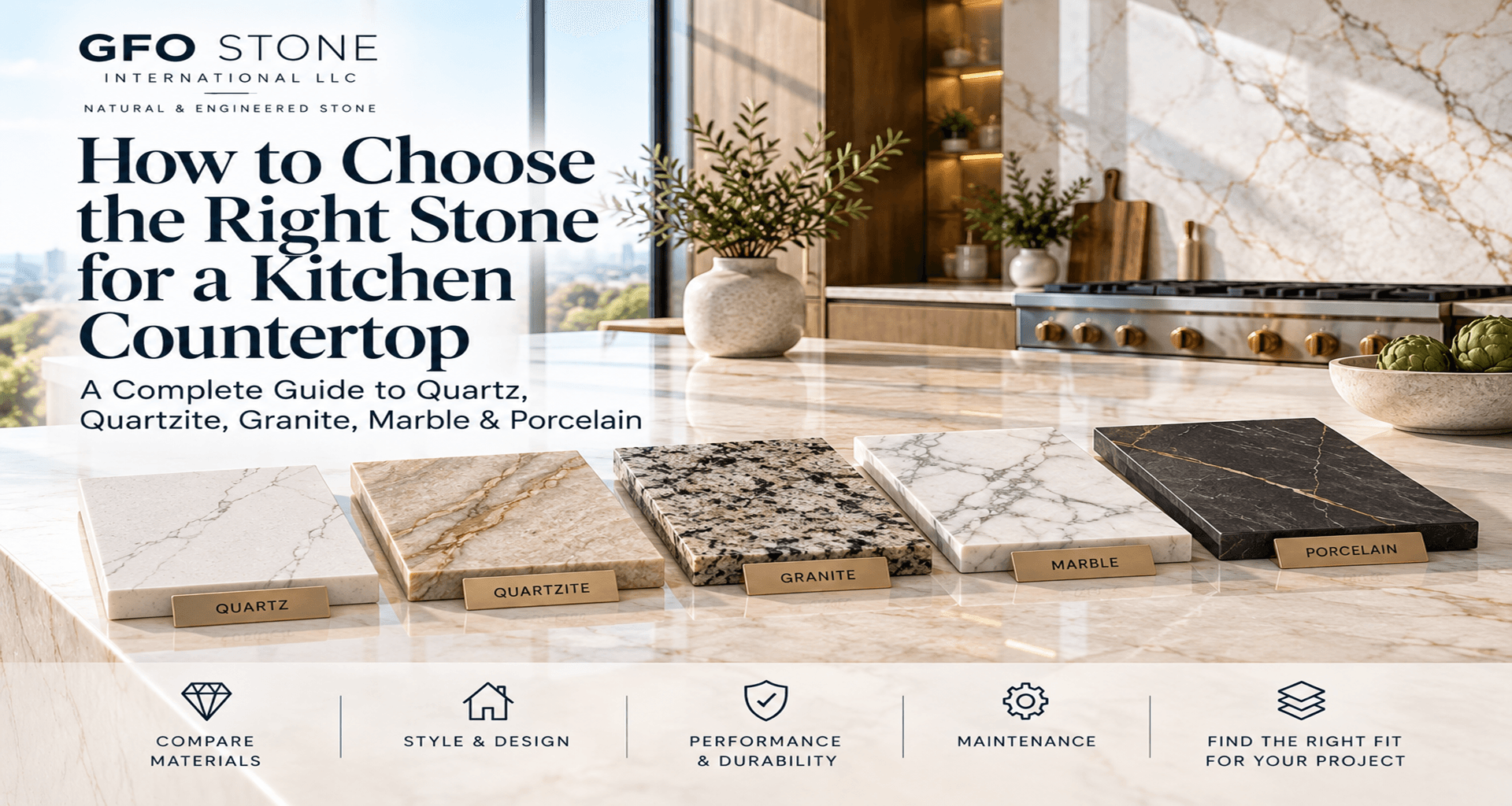
Choosing the right stone for a kitchen countertop is about more than finding a color you like. The material needs to work with the project's design, intended use, fabrication requirements, maintenance expectations, slab dimensions, availability, and budget.
For homeowners, designers, architects, builders, contractors, and fabricators, understanding the differences between Quartz, Granite, Marble, Quartzite, and Porcelain can make the selection process much easier.
At GFO Stone, we supply premium natural and engineered stone slabs to fabricators, contractors, designers, architects, builders, and other trade professionals. Here is what to consider when selecting a countertop material for your next kitchen project.
1. Start With the Overall Kitchen Design
The countertop is one of the largest visual surfaces in a kitchen, so the material should complement the cabinetry, flooring, backsplash, hardware, and overall design direction.
Consider whether the project calls for:
- A clean, contemporary appearance
- Subtle movement and veining
- Dramatic natural stone
- A classic marble-inspired look
- A bold statement surface
- A consistent pattern across multiple slabs
- A natural, one-of-a-kind appearance
White and neutral stones remain popular for kitchens because they can complement a wide range of cabinetry and interior styles. However, darker stones, dramatic veining, and distinctive natural patterns can create a strong focal point.
The best selection begins with the overall design—not simply the countertop itself.
2. Understand the Difference Between Natural and Engineered Stone
One of the first decisions is whether the project should use natural stone or engineered stone.
Natural stones such as granite, marble, and quartzite are formed through geological processes. Their appearance can include natural variations in color, veining, mineral deposits, movement, and texture.
Engineered quartz is manufactured to provide a controlled and repeatable surface appearance. Modern quartz collections offer a wide variety of colors and patterns, including designs inspired by natural stone.
Neither approach is universally better. The right choice depends on the requirements and design goals of the project.
3. Consider Quartz for Consistency and Design Flexibility
Quartz is an engineered surface available in a wide range of colors, patterns, and finishes.
One of its key advantages for project planning is visual consistency. Manufactured patterns can provide a more predictable appearance across multiple slabs, which can be valuable for kitchens requiring coordinated surfaces.
Quartz is commonly considered for:
- Residential kitchens
- Multifamily developments
- Bathroom vanities
- Hospitality projects
- Commercial interiors
- Large-scale residential developments
For projects where consistent appearance and straightforward routine care are important considerations, quartz can be a practical option.
4. Consider Quartzite for Natural Character
Quartzite is a natural stone formed from quartz-rich sandstone that has undergone intense heat and pressure over geological time.
Its natural formation creates distinctive movement, veining, color variation, and mineral characteristics. Individual slabs can look significantly different from one another, which is part of the appeal of natural stone.
Premium quartzites such as Taj Mahal, Super White, Crystallo, Mont Blanc, White Macaubas, and Fusion are frequently considered for high-end kitchen applications.
Quartzite can be an excellent choice when the design calls for authentic natural stone and a unique slab appearance.
Because natural variation is inherent to quartzite, reviewing actual slabs is particularly important before fabrication.
5. Consider Granite for Proven Natural-Stone Performance
Granite has long been used for kitchen countertops and remains a popular natural-stone option.
Granite is available in a broad range of colors and patterns, from relatively uniform surfaces to highly distinctive stones with dramatic mineral movement.
When selecting granite, consider:
- Color
- Pattern
- Slab dimensions
- Finish
- Thickness
- Application
- Maintenance requirements
- Availability
Granite can be particularly appealing for projects seeking the character of natural stone with a wide selection of styles.
6. Consider Marble for Timeless Design
Marble is one of the most recognizable natural stones in architecture and interior design.
Its veining and movement can create an elegant, sophisticated appearance that works particularly well in luxury kitchens.
Popular marble looks range from soft white backgrounds with delicate gray veining to dramatic stones with bold movement and contrasting colors.
Marble does require more consideration when selecting a kitchen countertop. The project team should understand the characteristics of the specific marble, including its susceptibility to scratching, etching, staining, and other changes associated with everyday use.
For many designers and clients, the natural beauty and character of marble are precisely what make it desirable.
7. Consider Porcelain for Contemporary Applications
Porcelain surfaces offer another option for modern kitchen design.
Porcelain is manufactured and can be produced in a variety of colors, patterns, and finishes, including designs inspired by natural stone.
Large-format porcelain can also provide design flexibility for applications where large surface areas are desired.
As with any countertop material, the fabricator should confirm that the selected product is appropriate for the intended application and follow the applicable fabrication and installation requirements.
8. Compare Durability and Everyday Use
Kitchen countertops experience daily wear, so the intended use of the space should influence material selection.
Think about how the kitchen will be used:
- Is it a primary family kitchen?
- Is it a luxury show kitchen?
- Is it part of a multifamily development?
- Will it receive heavy daily use?
- Is the appearance more important than minimizing maintenance?
- Will the countertop be exposed to heat, spills, or abrasive materials?
Different materials have different physical characteristics, so the project team should evaluate the technical information for the exact product being considered.
A material that is ideal for one application may not be the best choice for another.
9. Think About Maintenance Before Selecting the Stone
Maintenance should be discussed before the material is selected—not after installation.
Engineered quartz is generally selected for relatively straightforward routine cleaning.
Natural stone maintenance varies by material. Some natural stones may require periodic sealing, while others require additional care to minimize staining or surface changes.
Marble, for example, can develop etching from exposure to acidic substances. Natural stone can also vary in porosity and maintenance requirements.
Always review the care and maintenance recommendations for the specific stone and finish.
10. Look at the Actual Slab
A small sample is useful for evaluating color and general appearance, but it cannot always communicate the full character of a slab.
This is especially important with natural stone.
A full quartzite or marble slab may reveal:
- Veining direction
- Large areas of movement
- Mineral deposits
- Color variation
- Natural fissures
- Pattern transitions
- Areas of contrasting color
For large islands and prominent countertop applications, the actual slab should be reviewed whenever possible.
The goal is to understand exactly what the finished material can look like before fabrication.
11. Check Slab Dimensions
Slab size is an important consideration, particularly for large kitchen islands.
Before specifying a material, determine:
- Slab length
- Slab width
- Thickness
- Number of slabs required
- Expected fabrication yield
- Seam locations
- Island dimensions
- Backsplash requirements
Jumbo and super-jumbo slabs can provide additional flexibility for large applications and may help fabricators optimize layouts depending on the project.
Always verify the actual available dimensions rather than relying solely on standard product specifications.
12. Consider Veining Direction and Layout
For heavily veined materials, slab layout can dramatically affect the final appearance.
Designers and fabricators should consider whether the project requires:
- Bookmatching
- Vein matching
- Directional movement
- Consistent orientation
- Specific vein placement
- Multiple slabs with coordinated appearance
These considerations are particularly important for premium marble and quartzite kitchens where the stone itself is intended to be a major design feature.
Early communication between the designer, contractor, fabricator, and stone supplier can help avoid surprises later in the project.
13. Confirm Material Availability
A material can look perfect on a sample board and still create challenges if sufficient inventory is not available.
Before finalizing a countertop specification, confirm:
- Current inventory
- Number of slabs available
- Slab dimensions
- Thickness
- Finish
- Lot or batch information where applicable
- Expected availability of additional slabs
- Project schedule
For multifamily, hospitality, and other large-scale projects, availability should be evaluated early.
At GFO Stone, trade customers can work with our sales team to review available slabs and identify materials appropriate for their project requirements.
14. Consider the Fabrication Requirements
The stone supplier provides the slab; the fabricator transforms that slab into the finished countertop.
For this reason, the selected material should be evaluated with the fabricator before the project is finalized.
Fabricators should review the specific material's requirements for:
- Cutting
- Tooling
- Edge profiles
- Seams
- Cutouts
- Support
- Handling
- Installation
- Finishing
GFO Stone is a stone supplier and distributor. GFO Stone does not fabricate, cut, or install countertops.
Our role is to provide professional trade customers with access to natural and engineered stone slabs for their projects.
15. Balance Appearance, Performance, and Budget
The most attractive stone is not necessarily the best choice for every project.
A successful countertop selection balances three major considerations:
Appearance — Does the material achieve the desired design?
Performance — Is the material appropriate for the intended application and expected use?
Project requirements — Are the required quantity, slab dimensions, availability, maintenance expectations, fabrication requirements, and budget aligned?
The right material is the one that satisfies the project's priorities without creating unnecessary complications later.
Quick Comparison: Kitchen Countertop Materials
| Material | Type | Design Character | Consistency | Maintenance Considerations |
|---|---|---|---|---|
| Quartz | Engineered | Wide range of designs | Generally high | Generally straightforward routine care |
| Quartzite | Natural stone | Natural movement and veining | Naturally variable | Depends on stone and finish |
| Granite | Natural stone | Broad range of natural patterns | Naturally variable | Depends on stone and finish |
| Marble | Natural stone | Classic, elegant veining | Naturally variable | Requires additional care considerations |
| Porcelain | Engineered | Wide range of colors and patterns | Generally high | Follow product-specific recommendations |
This table provides a general comparison. Characteristics can vary by individual product, finish, manufacturer, and application.
Which Kitchen Countertop Material Is Right for Your Project?
There is no universal answer.
Choose quartz when consistency, design flexibility, and straightforward routine maintenance are important priorities.
Choose quartzite when natural stone character, distinctive movement, and dramatic veining are central to the design.
Choose granite when you want the natural character of stone with a broad selection of colors and patterns.
Choose marble when timeless natural beauty and distinctive veining are key design priorities and the project is appropriate for marble's maintenance considerations.
Choose porcelain when a manufactured surface with contemporary design options and large-format possibilities fits the project requirements.
The most important step is to evaluate the specific material and actual slabs, rather than selecting a category based only on general assumptions.
Work With GFO Stone on Your Next Kitchen Project
Selecting the right countertop material starts with having access to the right stone.
GFO Stone International LLC is a Stone supplier and distributor of premium natural and engineered stone slabs, serving fabricators, contractors, designers, architects, builders, and other stone professionals.
Our collections include:
- Quartz
- Quartzite
- Granite
- Marble
- Porcelain
From residential kitchens to multifamily, hospitality, and commercial projects, our team can help trade customers review available materials, slab sizes, and current inventory.
GFO Stone does not fabricate, cut, or install countertops. We supply slabs to qualified trade professionals who handle fabrication and installation.
Visit a GFO Stone showroom or contact our sales team to discuss your project and current material availability.
GFO Stone International LLC
Natural & Engineered Stone
Explore GFO Stone's premium stone collections and connect with our sales team for our current pricing and availability.